Dry Eye Services New Hampshire
Individuals suffering from Dry Eye Syndrome (DES) or Ocular Surface Disease often complain of constant burning or stinging in their eyes. Almost 12 million Americans suffer from this condition. The most common symptoms include one or all of the following: eye pain, a sandy sensation, redness, decreased tolerance to contact lenses, styes of the eyelids, and sensitivity to light. Despite the name “dry eye” many patients excessively water due to the eye trying to make up for the lack of regular lubrication/oils. Many DES patients also suffer from fluctuating vision changes, especially after reading for a prolonged period of time. In the early stages, the symptoms may be non-existent, or may seem to come and go.
So what is Dry Eye Syndrome?
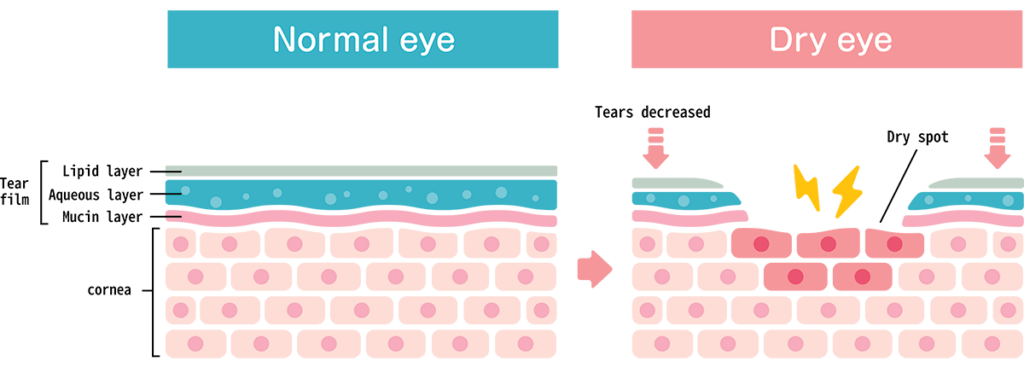
The surface of your eye is covered with a tear film layer that functions as a moisture barrier, and protects the eye from airborne debris and chemicals by flushing these contaminants from the eye. This layer is refreshed each time you blink through 3 types of glands on the eye and in the eyelids. If your tear film is inadequate, then you are without its protection, leading to the symptoms described above. Dry eye is multifactorial and often requires a combined treatment program.
Dry Eye Treatment Portsmouth
There are many things that can lead to DES, including environmental conditions, eyelid disorders, systemic diseases such as rheumatoid arthritis, lupus, and sarcoid, increasing age, some medications and nutritional deficiencies. There are many causes of dry eyes. Aging is certainly a factor; as people age, they secrete fewer tears, leading to dryness. Hormone depletion undoubtedly plays a role, as dry eyes are also more common in women than men, especially post-menopausal women. The tear film is made up of three layers; the lipid layer- thin and oily, the aqueous layer providing oxygen and nutrients, and the inner most layer which coats the eye with a substance called mucin that enables tears to stick to the eye’s surface.
Treatments and Solutions
Dry eye has no definitive cure, but a treatment regimen can be created based on the cause of your dry eyes. Our highly trained staff and dry eye specialists will work with you to provide relief, comfort and improve your quality of life. Treatments include artificial tears, punctal plugs, medicated eye drops, Omega-3 oral Supplements, in-office IPL and tear care treatments, amniotic memebranes and serum autologous tears.
Amniotic Membranes
Eyesight offers cryopreserved as well as dehydrated regenerative amiograft membranes from donor placental tissue to heal and optimize the corneal surface. They have been shown to reduce corneal scarring, lessen healing times, as well as improve corneal nerve innervation in conditions such as corneal neuropathy. They may be used to optimize the corneal surface prior to cataract and other ocular surgeries.
Serum Autologous Tears
The serum in your own blood holds healing and anti-inflammatory properties not available in artificial tear drops. Serum may be separated out of the blood after a blood draw and combined with solution into sterile, preservative-free dropper bottles to be used up to 6 times daily in the eyes for moderate to severe dry eye.
Artificial Tear Drops
The most popular and widely available of all dry eye treatments is supplemental lubrication, or artificial tears. There are many types and brands over-the-counter that may provide quick, but temporary symptomatic relief. Knowing which tears are best to co-manage your condition is important. Most generic or store-named brands have preservatives that can aggravate the condition, and can even kill corneal cells making dry eyes worse. Tears that promise to “get the red out” may reduce circulation in the eye, decrease production of the tear film, and eventually make your eyes even drier.
Nutritional Supplements
Omega-3 supplements have been shown in studies to improve the signs and symptoms of dry eye. The vast variety of supplements available on the market can seem overwhelming. It is important to discuss these options with a dry eye specialist, as well as review them with your primary care provider in case of any contraindications.
Meibomian Gland Dysfunction (MGD)
Many people suffer from evaporative dry eye due to meibomian gland dysfunction (MGD). MGD leads to a lack of oil production from the glands of the eyelids. Without regular, robust oil production, the tears evaporate more quickly in between blinks. Read about tear care and IPL below for in-office treatments of MGD.
Prescription Dry Eye Drops (such as Restasis or Xiidra)
For daily use to treat dry eyes. Some are intended to help increase your eye’s natural ability to produce tears by controlling the inflammation affecting the glands. Some stabilize the tear film by linking the lipid (oily) layer together on the surface and preventing tear evaporation. Some activate the temperature receptors on the eye to stimulate the glands to produce tears more regularly. Each year more options become available and your dry eye specialist can help you understand which drops are best for your individualized case.
Punctal plugs / Occlusion
Small, dissolvable plugs or hyaluronic acid gel can be inserted in the puncta (drainage canals) of the eyelids to prevent tears from draining too quickly from the eyes and increase the tear reservoir in the eye. Application is painless and patients are often surprised by how simple the procedure really is. Silicone plugs may be used in some cases, as well as permanent cauterization of the puncta.
TearCare for MGD
TearCare is a treatment utilizing a heating device that provides targeted, sustained heat for 15 minutes to the eyelids. Afterwards, your dry eye specialist will manually express your Meibomian glands at the slit lamp. Once cleared, your glands may now release fresh, new oils more effectively. This stabilizes the oily layer and minimizes evaporation of tears between blinks, treating MGD at the source
LipiScan
The LipiScan imaging system accurately photographs the length and size of the meibomian glands in the eyelids, assisting your dry eye specialist in diagnosing and following the progression of MGD. It is a useful educational tool to understand MGD.
Blepharitis
Blepharitis is the term for inflammation of the eyelid, usually by bacterial or parasitic over-population of the eyelids. It often accompanies certain types of skin conditions such as rosacea and dermatitis.
Blepharitis has two basic forms:
- Anterior blepharitis, affecting the outside front of the eyelid where eyelashes are attached.
- Posterior blepharitis, which is a dysfunction of meibomian glands. Meibomian glands are found within the eyelids and secrete oils to help lubricate the eye.
Common symptoms of blepharitis include tearing, dryness, crusting and redness. The condition often exacerbates MGD and may lead to recurrent styes (hordeolum). Blepharitis is a very common condition. Treatments usually include lid cleansing, BlephEx procedure, warm compresses and/or certain types of prescribed eye drops/ointments.
BlephEx System
The BlephEx system utilizes a patented hand piece containing a spinning medical-grade micro sponge that is passed along the edge of the eyelids and lashes, removing scurf and debris and exfoliating the eyelids.
The BlephEx treatment will reduce and alleviate the symptoms associated with blepharitis.
How is dry eye treated using Intense Pulsed Light (IPL)?
Intense Pulsed Light (IPL) therapy has been used as a treatment option for dry eyes after it was discovered that treating patients with IPL for rosacea and other skin conditions was also improving their dry eye. The FDA-approved IPL device emits pulses of 400-1200 nm light in the skin of the eyelids and surrounding areas. This targets the Meibomian gland cells and blood vessels, reducing inflammation and improving gland oil release. Thereby reducing evaporation of tears and improving the quality and quantity of the tear film.
During an IPL treatment for dry eye, the patient is given protective eyewear, and a cooling gel is applied to the skin around the eyes. Patients must return for multiple sessions (usually once monthly for 4 sessions) for a combined effect. It is important to note that it may take all 4 sessions before symptoms improve as each case is different.
Frequently Asked Questions about IPL:
Interested in meeting with one of our specialists?
Dr. Lauren McLoughlin and Dr. Renee Lynch, our Dry Eye Specialists, are seeing patients in our Ocular Surface Wellness (OSW) clinics in our Somersworth and Exeter locations. Our scheduling department can arrange an appointment for you by calling 603-436-1773 or request your appointment on line.
Once an appointment has been scheduled, we encourage you to complete our Dry Eye Questionnaire and bring it with you to your appointment.